
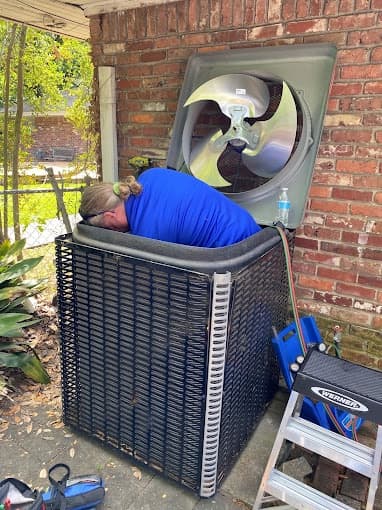
A heat pump moves heat, it does not make it
A furnace burns fuel and produces air well above body temperature in short bursts. A heat pump runs your air conditioner backwards, collecting heat from outdoor air and releasing it indoors. There is usable heat in outdoor air even at 40 degrees.
The consequence is supply air that is warm but below body temperature, so it reads as cool on your hand while the house is heating. Long run times are also correct. Judge a heat pump by whether the house holds its setpoint.
Defrost is not a malfunction
In heating mode the outdoor coil runs colder than the outdoor air, so moisture condenses on it and freezes, and Houston air is humid enough that our coils frost at temperatures a drier climate would shrug off. The board reverses the system briefly, stops the outdoor fan, and brings in auxiliary heat so you are not blown with cold air.
From the yard that looks alarming: a steaming outdoor unit and a whoosh as the reversing valve shifts. That is the system working. Solid ice encasing the coil, or a defrost cycle that never ends, is not.
Auxiliary heat and the EM HEAT button
When the heat pump cannot keep up, and during defrost, electric resistance strips in the air handler make up the difference. They use considerably more electricity per unit of heat than the compressor, which is why the thermostat calls for them only when it must.
EM HEAT bypasses the compressor and runs on strips alone, for the case where the outdoor unit has failed. Left on all winter it heats your house expensively while a working compressor sits idle, so either someone set it and forgot or there is a fault worth diagnosing.
What actually fails
The reversing valve is the part unique to heat pumps. It can stick between positions or leak internally, which shows up as a system that cools fine and heats poorly, or one that will not change modes. Defrost boards and sensors fail and the coil ices over.
Charge matters more than people expect: a system slightly low on refrigerant often still cools acceptably in summer and then heats badly the following winter, because heating is the harder job. Auxiliary strips also fail quietly, and nobody finds out until the first cold snap.
What we check on a heat pump
- Reversing valveConfirmed to shift fully in both directions and not leaking internally between ports.
- Defrost controlBoard, sensor, and termination, since a cycle that never ends or never starts both ice the coil.
- Refrigerant chargeVerified by subcooling, superheat, and coil temperatures, because low charge hurts heating first.
- Auxiliary heat stripsEach stage and its sequencer tested, as failed strips stay invisible until a genuinely cold night.
- Outdoor coil and drainageCoil cleanliness and clear drainage, so defrost water leaves instead of refreezing under the unit.
- Thermostat configurationStaging and heat pump settings, since a thermostat configured for a furnace runs the system wrong.