
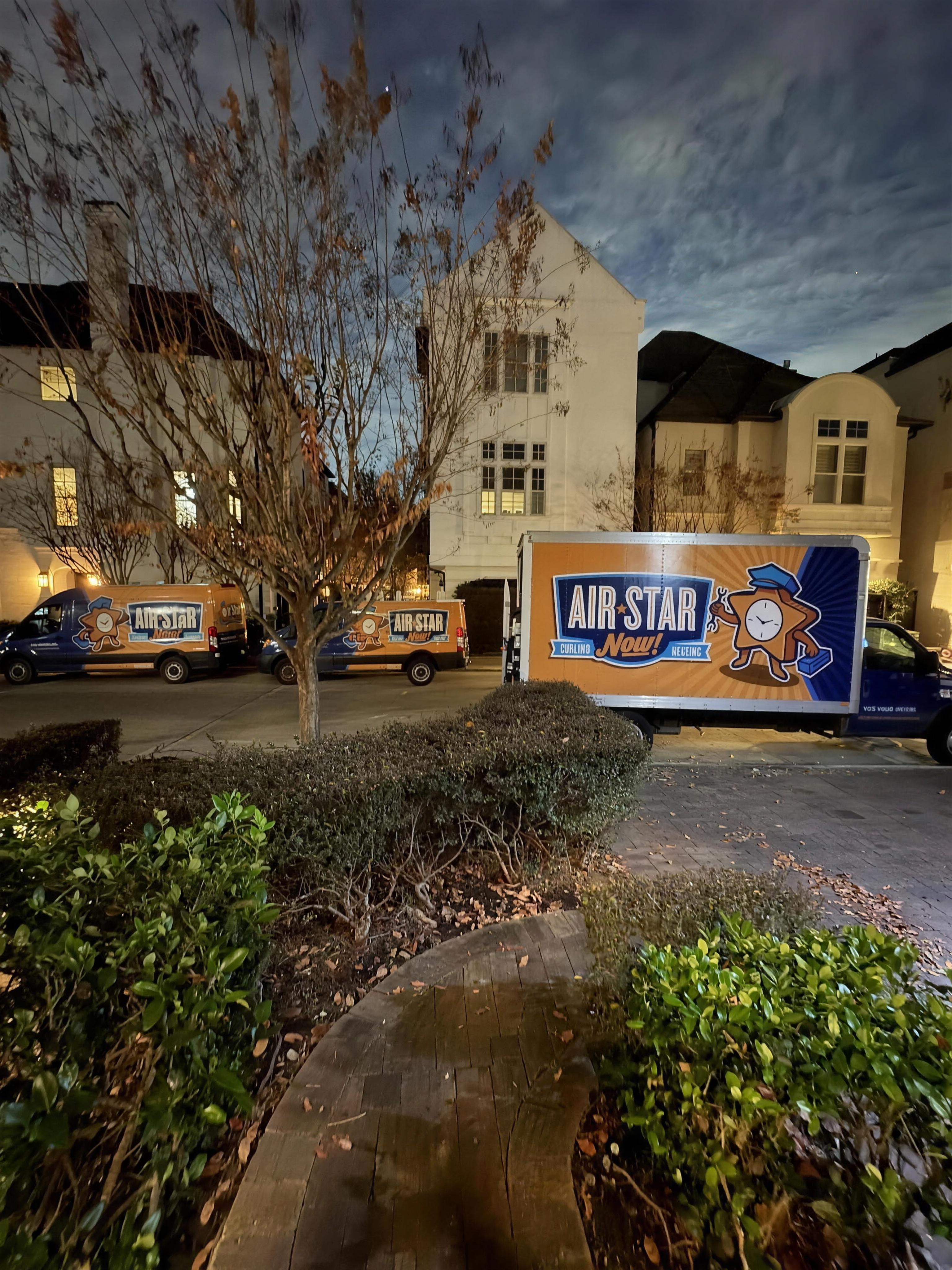
Who you are dealing with
Billy Wagner started on the commercial side: four years in commercial HVAC, then a government contract in Afghanistan covering air conditioning, plumbing, electrical, and custom fabrication. He then spent about fifteen years working with his father, who owned a small HVAC company, before founding Air Star Now.
Commercial is not a line added to a residential business. It is where the owner learned, and it shows in the work we take on: rooftop equipment, staged replacements, and buildings where the answer has to account for occupancy rather than one thermostat.
Scheduling around the building
We are open 24 hours, seven days, which for a commercial client mostly means the planned work can happen while the building is empty. Filter and belt changes, coil cleaning, economizer repairs, and most changeouts are better done at night or on a weekend.
Access is the constraint that gets underestimated. Roof hatches, ladder keys, escorts, tenant notice, and crane placement all carry lead times of their own, so tell us how your building works on the first visit and we will schedule around it.
Diagnosis on commercial equipment
The recurring faults on rooftop and split equipment are predictable: pitted contactors, capacitors, condenser fan motors, belts and bearings, refrigerant and compressor problems, and staging faults that leave one stage doing all the work. Economizers fail silently, and an actuator stuck open pulls hot outside air into the building all summer while the compressors run flat out.
On commercial equipment the failure history matters more than the individual part. A unit that has taken three condenser fan motors in two years is telling you something about airflow, voltage, or heat load, and a fourth motor is not an answer.
Planned replacement instead of emergency replacement
Equipment replaced in a crisis costs more, takes longer, and lands in whatever week is worst for you. Replaced on a plan, it gets a curb adapter fabricated ahead of time, a crane pick booked for a Saturday morning, and an order placed early enough that lead times are somebody else's problem.
The starting point is a survey: every unit recorded with make, model, serial, age, refrigerant type, and honest condition. From that you can sequence replacements across budget years instead of guessing which rooftop is the next emergency.
What a commercial service visit covers
- Unit by unit recordsMake, model, serial, age, refrigerant type, and condition captured for every piece of equipment.
- ElectricalContactors, capacitors, connections, and amp draws logged so drift shows up before failure does.
- AirflowFilters, belts, bearings, and static pressure, since airflow problems masquerade as capacity problems.
- Refrigerant circuitPressures, superheat and subcooling, and compressor performance, rather than topped off and left.
- Economizer and dampersActuators, linkages, and controls verified, because a stuck damper runs compressors against outside air.
- Condensate and roofPans, drains, traps, and the condition of curbs and roof penetrations around each unit.