
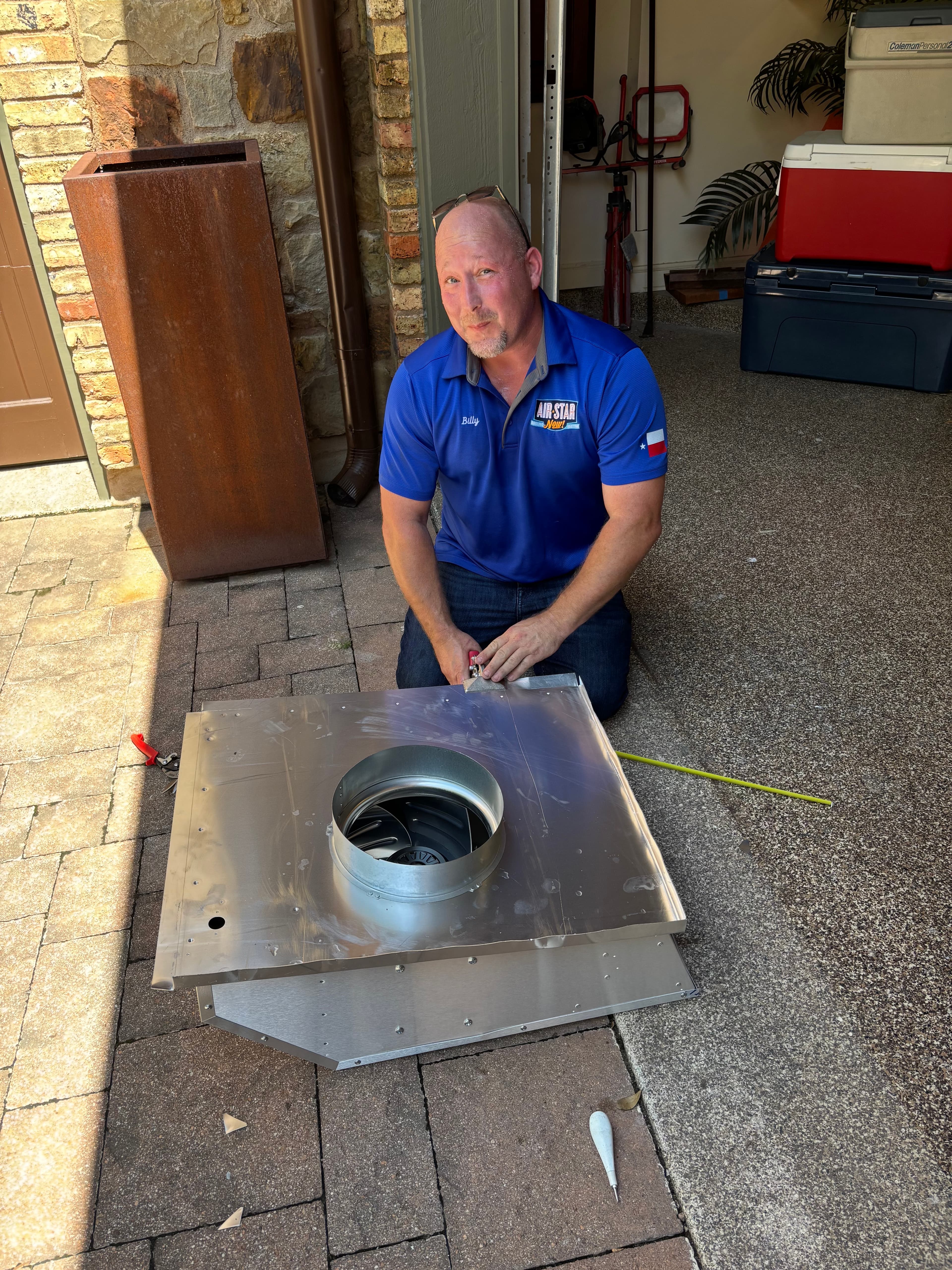
- The most common causes are the simplest: a thermostat set to "on" instead of "auto," or a clogged air filter choking off airflow — both are free DIY checks you can do in five minutes.
- If the indoor fan is blowing warm air while the outdoor unit sits silent, suspect a tripped breaker, a worn-out capacitor, or a failing compressor.
- Ice on the copper refrigerant line means a frozen evaporator coil — shut the AC off (leave the fan on to thaw) and call a pro before it damages the compressor.
- Low refrigerant is always a leak, never something that gets "used up" — a proper fix finds and repairs the leak, not just a top-off.
- In Houston's 95°F-plus summers, a warm-blowing AC becomes a same-day safety issue for kids, seniors, and pets — don't wait it out.
Why is my AC blowing warm air?
If your air conditioner is running but blowing warm or room-temperature air, it means the system can no longer pull heat out of your home. That happens for one of two reasons: either the cooling process has stopped (a refrigerant, coil, or compressor problem) or air is moving through the vents without ever getting cooled (a thermostat, filter, or power problem).
The seven most common causes are: (1) the thermostat is set wrong, (2) a dirty or clogged air filter, (3) a tripped breaker or the outdoor unit has lost power, (4) low refrigerant from a leak, (5) a frozen evaporator coil, (6) a dirty outdoor condenser coil, and (7) a failed capacitor or compressor.
The good news: the first three are things you can check yourself. The last four usually need a licensed tech. In Houston, where the outdoor unit fights 95°F-plus heat and heavy humidity for months on end, all seven show up regularly — so don't assume the worst before you rule out the simple stuff.
Start with the 3 things you can check yourself
Before you call anyone, walk through these three. They're free, they take about five minutes, and they're the reason a lot of "emergency" calls turn out to be a two-minute fix.
Thermostat settings: Make sure it's set to COOL, the temperature is below the current room temp, and the fan is on AUTO — not ON. When the fan is set to ON, it blows air constantly even when the system isn't cooling, so you feel room-temperature air between cycles and think the AC has failed. Also check that no one bumped it into HEAT mode.
Air filter: A clogged filter is one of the single most common causes of an AC blowing warm air. It starves the system of airflow, which drops cooling capacity and can freeze the coil. In dusty Houston homes running the AC nearly year-round, filters need changing every 30–90 days. A new one costs about $15–$40.
Breaker and outdoor unit: Your AC has two power sources — the indoor air handler and the outdoor condenser. If the outdoor breaker trips, the indoor fan keeps blowing (warm) air while the outdoor unit sits dead. Check your electrical panel, and go outside and listen: if the big outdoor unit is silent while air is still coming from your vents, that's your clue. Reset a tripped breaker once — but if it trips again, stop and call a pro, because that's a sign of a real electrical fault.
When warm air means a refrigerant or frozen-coil problem
If the simple checks came up clean, the next suspects involve refrigerant — and these need a licensed technician.
Low refrigerant from a leak: Refrigerant is what actually absorbs heat from your home's air. It doesn't get "used up" like gas in a car — if the level is low, you have a leak, period. As the charge drops, the air gets progressively warmer and your energy bills climb. Any tech who tries to just "top it off" without finding the leak is taking your money; the right fix is to locate and repair the leak, then recharge to spec.
Frozen evaporator coil: This is the one to catch early. Low airflow (dirty filter, weak blower) or low refrigerant can cause the indoor coil to drop below freezing, and moisture in Houston's humid air turns to ice on the coil and the copper line. Ironically, a block of ice can't cool anything, so warm air comes out. If you see ice on the copper refrigerant line or water pooling near the indoor unit, turn the AC OFF but leave the fan set to ON to help it thaw, and call a tech. Running a frozen system can damage the compressor — a much more expensive repair.
Electrical and mechanical failures that stop the cooling
The remaining causes are hardware failures in the outdoor unit — common in Houston because the condenser runs so many hours in extreme heat.
Dirty outdoor condenser coil: The outdoor unit dumps your home's heat into the outside air. When its coils are caked with dust, grass clippings, cottonwood, or mud, it can't release that heat, so the air inside stays warm. Keep at least two feet clear around the unit and gently rinse the fins if they're visibly dirty. Deep cleaning is part of a proper tune-up.
Failed capacitor: The capacitor is a small part that gives the compressor and fan motor the jolt they need to start. Houston's relentless summer runtime and heat wear capacitors out fast, and a dead one is a very common reason the outdoor unit hums or sits silent while warm air blows inside. It's usually an affordable, same-day fix.
Failed compressor: The compressor is the heart of the system. When it fails, cooling stops entirely. This is the most expensive item on the list, and on an older unit it's often the moment to weigh repair against replacement. An honest tech will show you both numbers and let you decide — no pressure.
How much does it cost to fix an AC blowing warm air in Houston?
Costs vary with the part, the brand, and how old your system is, so treat these as honest Houston-area ballparks, not a quote — a real number comes after a tech actually diagnoses the unit.
Diagnostic / service call: roughly $75–$150 (many companies, including ours, credit this toward the repair if you move forward).
Common repairs: capacitor replacement about $150–$400; contactor about $150–$350; a refrigerant leak repair plus recharge anywhere from about $200 to $1,500+ depending on where the leak is and how much R-410A the system needs; a blower motor roughly $450–$900.
Big-ticket items: a replacement compressor commonly runs $1,200–$2,800+, and a full system replacement in the Houston market typically lands somewhere around $5,000–$12,000+ depending on size and efficiency. When a repair starts approaching the cost of replacement on a 12–15+ year-old unit, that's the point to have a straight conversation about which one actually saves you money.
When to call a pro — and why Houston heat makes it urgent
Call a licensed HVAC company if: the outdoor unit won't run or keeps tripping the breaker, you see ice or hear hissing (a refrigerant leak), the air stays warm after you've checked the thermostat, filter, and breaker, or you smell anything burning. Refrigerant and electrical work legally and safely require a licensed tech — in Texas, look for a company that carries a state HVAC license.
This isn't a repair to sit on in Houston. When it's 95–100°F outside with our brutal humidity, an indoor temperature can climb into the danger zone within hours, especially for kids, older adults, and pets. A warm-blowing AC on a July afternoon is a same-day problem, not a next-week one.
Air Star Now is a family-owned, licensed and insured HVAC company (Texas license TACLA36229C) that's served Greater Houston for over 10 years, with honest, upfront pricing and no high-pressure upsells. We're available 24/7 for emergencies — nights, weekends, and holidays — across Houston, Cypress, Katy, Spring, Tomball, Humble, Pearland, Baytown, La Porte, Texas City, Richmond, Sugar Land, and Missouri City. If your AC is blowing warm air, call (713) 929-9595 and we'll get a straight answer to you fast.
Related questions
If the system runs but never cools, air is moving without heat being removed. Start with the thermostat (set to COOL, fan on AUTO), a clogged air filter, and whether the outdoor unit lost power at the breaker. If those are fine, it's usually low refrigerant from a leak, a frozen evaporator coil, a bad capacitor, or a failing compressor — all jobs for a licensed tech.
Yes. A clogged filter starves the system of airflow, which lowers cooling capacity and can even freeze the indoor coil into a block of ice that stops cooling altogether. In dusty Houston homes running the AC most of the year, change your filter every 30–90 days. It's a $15–$40 fix that prevents far more expensive problems.
If you see ice on the refrigerant line, water around the indoor unit, or the breaker keeps tripping, turn the system off and call a pro — running it can burn out the compressor or point to an electrical fault. If it's just warm air with no ice or odd smells, it's fine to run while you check the thermostat and filter, but don't ignore it during a Houston heat wave.